Commercial Bakery Equipment Checklist: What to Buy at Every Stage of Growth
A restaurant cooks to order. A bakery works to a schedule. That difference is why bakery equipment cannot be chosen the way kitchen equipment is — and why buying the wrong oven in month one can cost you three years of margin.
In a restaurant kitchen, the equipment decides how fast you can cook. In a bakery, it decides whether your dough is even ready when you need it. Mixing temperature, fermentation time, proofing humidity and oven recovery are not preferences — they are process variables, and each one is set by a machine. Get them wrong and no amount of skill at the bench will rescue the batch.
That is why the standard "bakery equipment list" format fails so many people. A flat list of forty items tells you what exists. It does not tell you that a micro bakery should not buy a dough divider, or that a bakery producing 200 loaves a day needs a proofer twice the capacity of its oven, or that a retarder-proofer will save more labour than any other single purchase.
So this guide is organised the way a bakery actually grows: by production stage. Work out which stage you are at, take the list for that stage, then use the sizing rules and budget allocation further down to turn it into a purchasing plan.
1. Find your production stage before you write a shopping list
Bakery equipment decisions are driven by daily output far more than by menu style. Three stages cover almost every independent bakery, and the equipment that changes between them is remarkably consistent.
| Stage | Daily production | What defines it |
|---|---|---|
| Micro bakery | 1–10 batches a day | One or two bakers, hand skills still doing the work, retail counter attached to production. Equipment must be reliable and compact more than fast. |
| Growing bakery | 10–100 batches a day | Labour has become the constraint, not oven time. This is the stage where dough-handling machines and a real proofing cabinet pay for themselves. |
| High-volume bakery | 100+ batches a day | Wholesale, supply contracts or multiple outlets. Flow and throughput matter more than individual machine capability, and labour cost per unit is the metric to defend. |
Be honest about which row you are in. Most bakeries buy one stage ahead of their actual volume and then carry the fixed cost of equipment that never runs at capacity — which is a slower way of losing money than buying too little, but it loses the same amount.
2. The eight equipment groups — the complete checklist
Group 1 — Mixing and dough development
Where the product is actually made. Everything downstream is shaping and heat.
- Planetary mixer — the general-purpose machine. Handles cake batters, icings, fillings, mousses and light doughs. Countertop models from small capacities up to floor-standing units. Choose this if your range is cake, pastry and batter led.
- Spiral mixer — built specifically for dense bread dough. A spiral hook kneads without the warming effect of hand contact, so dough stays cooler during a long mix, which means better gluten development and more predictable fermentation. If bread is your core product, this is not an upgrade — it is the correct machine.
- Dough sheeter / laminator — rolls dough to a consistent, even thickness. Non-negotiable for laminated doughs: croissants, puff pastry, Danish. Hand-rolling at volume is neither viable nor repeatable, and consistent thickness is what produces even lamination, an even rise and a clean flake. Reversible (two-way) models cut handling, which matters because laminated dough must stay cold.
- Dough divider — portions a batch into equal, accurately weighted pieces. This is a consistency tool first and a labour tool second: equal weight means equal proof time and equal bake time, which is the only way to get the same loaf every day at volume.
- Dough rounder and moulder — shapes divided pieces into rounds or into the final loaf form. Usually bought with a divider as a set.
- Cookie depositor — drops consistent portions of cookie or biscuit dough onto trays. Even compact models handle a very high tray count per hour, and interchangeable nozzles cover everything from drop cookies to macarons. Worth it only if cookies are a significant line.
- Bread slicer — for retail loaves and buns. Decide by slice thickness range, product type and whether you need a countertop or floor model.
Group 2 — Ovens and baking
The single most consequential purchase in a bakery. Choose it last, after you know your product mix and volume — not first, because it looks impressive.
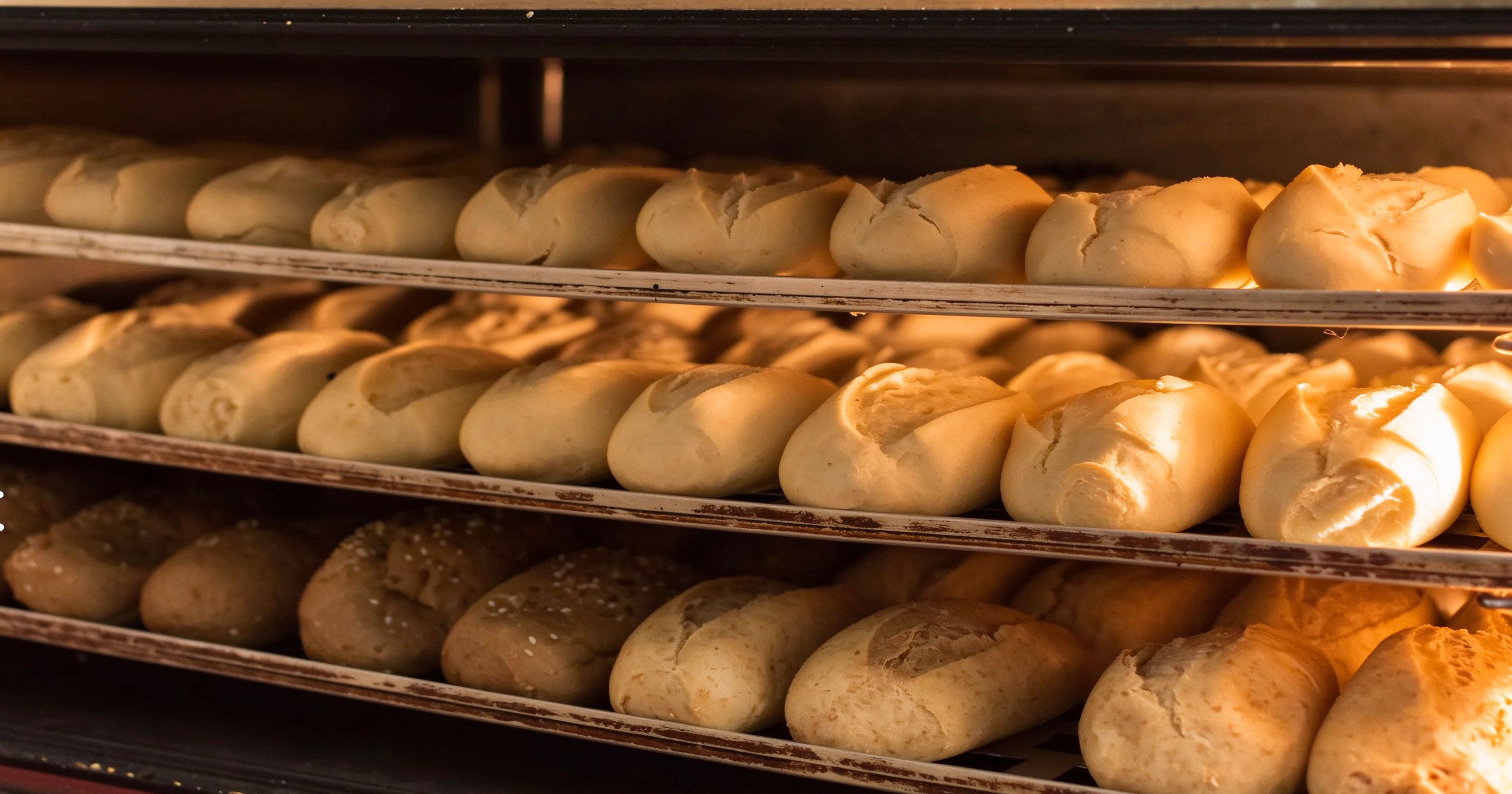
- Convection oven — fans circulate air for even browning and fast baking. The most common and usually the least expensive bakery oven, and the right first oven for cookies, pastries, cakes and general production. Bakery-depth models fit full-size pans side by side or front to back. Steam injection models handle crustier products and give better oven spring.
- Deck oven — bakes directly on a stone or ceramic deck, with no sheet trays. This is what produces the crust and open crumb that convection cannot fully replicate, and it is the standard for artisan bread and flatbread. Simple design, few moving parts, long service life. Takes more floor space than a convection oven, and manual, semi-automatic and automatic loading options change both labour and price considerably.
- Rotating rack oven — you wheel in a full pan rack rather than loading trays individually. The rotating rack promotes even baking without anyone turning trays, and steam control gives consistent browning and crust. This is the machine that lets a bakery scale from mid-size to genuinely high output without a proportional increase in labour.
- Revolving oven — large revolving trays, high capacity, popular for bagels, pizza dough and specific breads. Expensive, and only justified when output genuinely requires it.
- Combination and steam-injection ovens — one unit that roasts, steams, bakes and proofs. Highly versatile, and useful where floor space is the binding constraint rather than budget.
Buy stackable. A double-stack convection oven gives you roughly twice the output of a single unit in barely more floor space, and it can be bought as one now and two later. Stackability is the cheapest growth option in the entire bakery — and the one most often given up to save a little on the first purchase.
Group 3 — Proofing and fermentation
Inconsistent proofing is the most common cause of inconsistent bread, and the hardest fault to diagnose after the fact. This group removes the guesswork.
- Proofing cabinet — holds dough at controlled temperature and humidity so it rises at a predictable rate. Available in half, three-quarter and full height, most on castors so the whole cabinet can move to the oven. Roll-in models hold multiple full racks.
- Retarder / proofer combination — refrigeration to slow fermentation overnight, then automatic switch to proofing so dough is ready at the moment you need it. This is the single highest-value piece of equipment for a bakery baking fresh every morning: it lets one shift prepare the next day's bake, and it moves your production start time from the middle of the night to the evening before.
- Proofing pans, boxes and baskets — from plastic and metal proofing pans to traditional wicker bannetons for artisan loaves. Cheap, and the difference between a shaped loaf that holds its form and one that slumps.
- Pan racks / speed racks — up to 40 levels, holding dough in proof or finished product in cooling. Buy enough of them; racks are the cheapest way to stop baked goods from piling up on the one free table.
Group 4 — Refrigeration and freezing
- Reach-in refrigerators and freezers — ingredient storage for butter, eggs, cream and fillings, and short-term holding of dough to stop it over-proofing. Choose by number of sections; multi-section units with extra racks maximise storage in a small footprint.
- Walk-in cooler and freezer — the cheapest cold storage per cubic metre and the point at which a bakery stops shuffling trays between fridges. Justified once daily volume is high enough to need bulk ingredient holding.
- Roll-in refrigeration — takes a full bakery rack, so product moves from proofer to fridge to oven without being unloaded. A workflow decision as much as a storage one.
- Blast chiller / blast freezer — rapid chilling and freezing for par-baked production, make-ahead lines and wholesale supply. Essential at scale, unnecessary at start-up.
- Dough retarder — dedicated overnight fermentation control where a combined retarder-proofer is not required.
Group 5 — Work surfaces, portioning and storage
- Baker's table / baker's top — a work surface built for dough, typically with raised splash guards to contain flour and dough. Some include under-table storage. Wooden or stainless tops suit different tasks.
- Stainless work tables — 304-grade, the cheapest way to add usable production area. Castors where the table needs to move for cleaning.
- Scales — bench and floor. In a bakery, weighing is not a nicety; it is how the recipe stays the recipe. Have more than one, and keep them calibrated.
- Ingredient bins and storage boxes — for flour, sugar, salt and bulk dry goods. Label them. Rotate them.
- Commercial shelving — wire or epoxy-coated for dry storage, plastic or stainless for cold and damp environments. Modular systems let you add levels as volume grows.
- Utility carts and trolleys — the least glamorous purchase on this page and one of the highest-value. Moving heavy dough from mixer to proofer by hand is where production time disappears and where staff get hurt.
Group 6 — Smallwares and baking accessories
Individually cheap, collectively the difference between a working bakery and a frustrating one. Budget for a complete set, not a partial one.
- Mixing bowls, measuring cups and spoons, and a set of scales
- Whisks, rubber spatulas, bench scrapers, dough cutters
- Flour sifters and sieves
- Rolling pins and rolling pin covers
- Pastry bags, nozzles and piping tips; turntables for cake work
- Pastry brushes for egg wash and glazing
- Bun pans, sheet pans, tart and pie pans, loaf tins, cake tins
- Silicone baking mats and parchment
- Cooling racks — and enough of them, because cooling space is the most commonly underestimated constraint in a bakery
- Oven mitts, heat-resistant gloves, aprons and hairnets
- Thermometers — dough temperature, oven temperature and fridge temperature all need measuring, not guessing
Group 7 — Display, retail and packaging
- Refrigerated display case — cakes, cream pastries and anything perishable, held at safe temperature while being sold. Vertical and horizontal designs, self-service or served from behind the counter, with interior lighting that does a surprising amount of selling.
- Ambient display case — bread, bagels, pastries and packaged goods at room temperature. Most retail bakeries need a mix of refrigerated and ambient rather than one large case.
- Reach-in merchandisers — bulk retail display that doubles as storage for high-volume bakeries.
- Bread racks and baskets — display, and customer self-selection.
- Packaging and labelling — boxes, bags, ties, labels with allergen and date information. Label discipline is a legal requirement in most markets, not a branding choice.
- POS system — for a bakery, the till is also the production feedback loop. Which products sell out by 11 a.m. should change tomorrow's bake sheet, and a POS is how you find that out.
Group 8 — Ventilation, cleaning and safety
- Exhaust hood with grease filters — required over bakery ovens and fryers in most jurisdictions, and sized to the cooking load rather than the ceiling space available.
- Fire suppression and extinguishers — mandatory over cooking equipment in most markets. Budget for it as part of the ventilation package.
- Dedicated handwash basin — separate from the dishwashing and prep sinks.
- Three-compartment or dedicated dishwashing sink, and a dishwashing machine — bakeries generate an enormous volume of trays, bowls and utensils. This is a bottleneck more often than the oven is.
- Floor drains, non-slip flooring, and cleaning tools — flour plus water makes a genuinely dangerous floor. Plan drainage and slip resistance before the floor is laid, because retrofitting means demolition.
- Waste bins with lids and a grease or oil disposal arrangement where frying is involved.
3. The sizing rules that actually work
Most bakery equipment mistakes are sizing mistakes. These are the ratios worth designing around.
| Rule | Why it matters |
|---|---|
| Proofing capacity should be roughly double your baking capacity | Dough has to move from proofer to oven without waiting. If proofing and baking capacity are matched, the proofer becomes the bottleneck and product sits too long, over-proofing while the oven finishes the previous batch. |
| Size the mixer to your largest single batch, never its rated maximum | Batch size, dough hydration and daily usage determine the right capacity. A mixer run permanently near its limit will fail early and will not develop dough properly. If you are between sizes, buy the larger one with a step-down bowl. |
| Spiral for bread, planetary for cakes and batters | Spiral mixers develop dense dough without heating it. Planetary mixers are the general-purpose machine for batters, icings and light doughs. Buying one type to do both jobs badly is the classic false economy. |
| Buy stackable ovens, or plan for a second deck | Doubling output later is far cheaper if the first oven was stackable, and a multi-deck oven can be commissioned deck by deck. |
| Allow cooling space equal to roughly one bake cycle | Product leaving the oven has to cool somewhere before packing or finishing. Under-planned cooling space forces hot product into boxes, which softens crusts and ruins presentation. |
| Count pan racks, not just pans | A rack holds up to 40 levels. Running short of racks means product stacked on tables, which is how a bakery loses its organisation at exactly the busiest hour. |
The retarder-proofer deserves its own paragraph. It is expensive relative to a basic proofing cabinet, and it is the purchase that most often changes how a bakery operates. Dough prepared in the evening and retarded overnight can be proofed automatically to be ready at a set hour, which means the bake starts when you want it to rather than when the dough allows. For any bakery baking fresh daily, that single unit typically returns more value than the second oven it competes with for budget.
4. Must-have versus can-wait — by bakery type
Your product mix decides the order. This is the part a generic checklist cannot tell you.
| Bakery type | Buy first | Add as you grow |
|---|---|---|
| Artisan bread | Spiral mixer, deck oven, proofing cabinet, pan racks, baker's table | Retarder-proofer, dough divider and rounder, moulder, walk-in refrigeration |
| Pastry and laminated dough | Planetary mixer, reversible dough sheeter, refrigerated work surface, convection oven | Blast chiller, dough divider, retarder-proofer, second oven |
| Cake and celebration | Planetary mixer, convection oven, refrigerated display case, turntables and smallwares | Second mixer, blast chiller, larger refrigerated display, dedicated decorating room |
| Cookie and biscuit | Planetary or spiral mixer, multiple convection oven decks, cooling racks | Cookie depositor, additional oven decks, automated packaging |
| Donut, bagel and fried | Spiral mixer, proofing cabinet, fryer with filtration, revolving or rack oven for bagels | Dough divider and rounder, automated fryer line, bulk refrigeration |
| Cloud / delivery-only bakery | Mixer, oven, refrigeration, work tables, packaging and labelling station | Dough handling machines, display refrigeration, second oven |
5. How to split your equipment budget
Absolute bakery equipment costs vary enormously by market, menu and scale, so any single figure is misleading. What transfers is the proportion. This is roughly how a commercial bakery equipment budget divides:
| Equipment group | Share of equipment budget | Notes |
|---|---|---|
| Ovens and baking | 30% | Largest single block. A rack oven will push this higher; a single convection oven much lower. |
| Mixing and dough development | 18% | Rises sharply once you add a sheeter or divider |
| Refrigeration and freezing | 16% | Dominated by whether you need a walk-in |
| Proofing and fermentation | 9% | A retarder-proofer alone can account for most of this |
| Shaping and finishing | 8% | Divider, rounder, moulder, slicer |
| Work surfaces, scales and storage | 7% | Tables, shelving, bins, racks, carts |
| Display and retail | 7% | Zero for wholesale and delivery-only bakeries |
| Ventilation, cleaning and safety | 5% | Often carried in the fit-out budget — check which, or you will double-count it |
Buy new where heat, pressure or a compressor is involved. Buy used where it is just steel. Ovens, mixers and refrigeration carry the tolerances that decide product quality, and they need warranty and a spares network — buy those new. Work tables, shelving, racks, carts and most smallwares have nothing meaningful to go wrong, so buying them used is a real saving rather than a gamble. Inspect anything used, and confirm it can be certified for commercial use in your market.
6. Layout: the bakery flow is a schedule, not just a line
A bakery's layout has to serve a process that runs on time rather than on orders. These are the rules that matter most.
- One-way flow: store → mix → divide → shape → proof → bake → cool → finish → pack → display. Dough should never travel backwards, and finished product should never pass back through the flour zone.
- Put the proofer next to the oven. The single most important adjacency in a bakery. Anything that delays the move from proofer to oven costs you product quality, not just time.
- Give cooling its own space between oven and packing. Not a table in a corner — a designated area with racks, because hot product in a box is a ruined product.
- Separate finishing and decorating from the flour zone. Flour dust travels. A clean, cool, dust-free area is what makes consistent icing, glazing and cream work possible.
- Keep mixing near bulk ingredient storage. Carrying 25 kg bags of flour across a kitchen several times a day is a labour cost and a safety risk.
- Group all heat under one hood. Ovens and fryers on one continuous exhaust run, sized to the cooking load rather than the space available.
- Plan aisles for trolleys, not people. A metre of clear aisle is not enough if a rack has to turn a corner. Move racks on paper first, then decide the layout.
- Settle utilities before ordering anything. Gas capacity, electrical load, water, drainage and floor gradients constrain a bakery layout more than the floor plan does.
7. Specifications to insist on, whatever brand you buy
- Stainless steel grade. 304 for all food-contact and wet surfaces. Cheaper 202 grades look identical on day one and pit within a year or two.
- Insulation and door seals on ovens and proofers. These decide energy consumption and temperature consistency far more than the control panel does. Ask for seal material and whether gaskets are a standard replaceable part.
- Steam and humidity control. For ovens, steam injection is what produces oven spring and crust. For proofers, humidity control is what stops dough drying out and forming a skin.
- Serviceability. Removable bowls and tanks, accessible elements and burners, off-the-shelf seals and gaskets. If it cannot be serviced in your city, it is not a bargain.
- Controls. Reliable and replaceable. Programmable retarders and ovens are genuinely useful, but obscure proprietary controllers become a maintenance trap in year three.
- Stackability and modularity. Ask whether the oven stacks, whether the proofer takes a standard rack, and whether shelving can be extended. Modularity is what makes growth affordable.
- Safety devices. Flame-failure protection, over-temperature cutouts, cool-touch handles, insulated panels, correctly rated wiring and earthing.
- Certification and warranty. The certifications your market requires, a written warranty, a spares commitment, and installation and training as part of the handover. Get all four in writing.
8. Mistakes that cost bakeries the most
- Choosing the oven before defining the product mix. The oven is the biggest decision and the last one you should make. Product type, volume and production flow decide it — not the size of the space or the appeal of the machine.
- Buying only for today's volume. The most common mistake in the sector. Equipment bought for current output becomes the constraint within eighteen months, and the resale value rarely covers the replacement.
- Matching proofer capacity to oven capacity. Proofing should run at roughly double baking capacity, or the schedule stalls every single day.
- Using a planetary mixer for bread dough at volume. It will work, for a while, and then it will fail — usually during your busiest week.
- Underestimating cooling and rack space. The cheapest items on the list and the most frequent cause of a bakery losing control of its own flow at peak.
- Ignoring the dishwashing load. Bakeries generate trays, bowls, utensils and moulds continuously. A wash area sized for a restaurant kitchen becomes a permanent bottleneck.
- Skipping ventilation and fire suppression budgeting. Both are legally required over bakery ovens in most markets, and both are far more expensive to retrofit than to install.
- Buying on price with no local spares network. A machine with no service support is not cheaper. It is a future production stoppage with a delivery date you cannot choose.
9. Lifespan and the routine that protects it
| Equipment | Typical service life | What shortens it |
|---|---|---|
| Ovens (convection, deck, rack) | 12–20 years | Failed door seals, dirty elements or burners, no calibration |
| Mixers (planetary, spiral) | 10–15 years | Running beyond rated batch capacity, worn belts, ignored gearbox service |
| Refrigeration and freezers | 10–20 years | Dirty condensers, failing door seals, overloading |
| Proofers and retarders | 8–15 years | Scale build-up in humidity systems, failed heating elements, dirty seals |
| Dough handling machines | 8–15 years | Running dry, blunt or misaligned rollers, no lubrication schedule |
| Display cases | 8–15 years | Dirty condenser coils, damaged gaskets, scratched glass |
| Frequency | Task |
|---|---|
| Every shift | Clean mixer bowls and hooks, wipe work surfaces and bench scrapers, check proofer water level and humidity, log fridge and freezer temperatures |
| Daily | Clean oven doors and glass, sweep and wash floors, clean proofing cabinets and racks, check dough temperatures at mix, empty and clean waste bins |
| Weekly | Deep-clean the hood and grease filters, inspect oven and proofer door seals, clean behind and beneath equipment, check and clean dough sheeter rollers, sanitise storage bins |
| Monthly | Clean condenser coils, calibrate scales and thermometers, check mixer belts and gearbox, descale proofer humidity systems, inspect electrical connections |
| Annually | Service ventilation and fire suppression, professional inspection of gas ovens and fryers, deep service on refrigeration, review whether any station has become the bottleneck |
Two habits with the best return: measure dough temperature at every mix, and clean your condenser coils monthly. The first is the earliest warning that fermentation is drifting, and the second is what keeps refrigeration running efficiently instead of failing quietly.
10. Frequently asked questions
What equipment does a new bakery need first?
Start with the equipment your main product requires. Most new bakeries need a commercial mixer, an oven, refrigeration, work tables, storage containers and shelving, baking pans, racks, scales and basic smallwares. Specialised machines — proofers, dough sheeters, dividers, slicers and display cases — can be added as volume grows and the need becomes obvious.
What is the best oven for a bakery?
It depends entirely on what you bake. Convection ovens suit cookies, pastries, cakes and general production, and are the usual first oven. Deck ovens are preferred for artisan bread and flatbread because baking directly on stone produces a crust and crumb that convection struggles to match. Rotating rack ovens give the highest capacity for production bakeries. Decide by product, volume and space — in that order.
Should I buy a spiral mixer or a planetary mixer?
Spiral mixers are designed for dense bread dough and knead without warming the dough, which gives better gluten development. Planetary mixers are the general-purpose machine for cake batters, icings, fillings and lighter doughs. A bread-focused bakery needs a spiral; a cake and pastry bakery needs a planetary; a bakery doing both eventually needs both.
Do I need a retarder-proofer or is a proofing cabinet enough?
A proofing cabinet controls temperature and humidity for consistent rising, and it is enough for a micro bakery baking within the same shift. A retarder-proofer adds controlled overnight fermentation with automatic switchover to proofing, so dough is ready at a chosen hour. It is the purchase that most changes how a growing bakery operates, because it decouples the bake start time from the middle of the night.
What size mixer do I need?
Work backwards from the recipe, not from the catalogue. Batch size, dough hydration and daily usage determine the right capacity. A small bakery producing cakes, cookies and light doughs may be fine with a countertop or small floor mixer, while heavy bread dough at volume needs a much larger spiral unit. Always choose a machine that can handle your largest batch without exceeding its recommended capacity — if you are between sizes, take the larger one with a step-down bowl.
When should a bakery upgrade to high-volume equipment?
When the current equipment cannot keep up with demand. The signals are consistent: production delays, repeated repairs, batch-to-batch inconsistency, rising labour cost per unit, and turning down or missing orders. At that point the decision is usually between adding a second unit of what you have and moving to a higher-capacity machine — and stackability determines which of those is cheaper.
How much does it cost to equip a bakery?
It varies too widely for a single figure to be meaningful — the difference between a micro bakery and a wholesale operation is an order of magnitude. Plan by proportion instead: ovens take around 30% of the equipment budget, mixing and dough development 18%, refrigeration 16%, with proofing, shaping, storage, display and ventilation sharing the remainder. Build the list first, then price it.
One-stop supply. Factory direct. MOQ = 1.
MightyChef Catering Equipment Co., Ltd. manufactures commercial bakery equipment in Guangzhou, China — planetary and spiral mixers, dough sheeters, dividers and rounders, proofing cabinets and retarder-proofers, convection, deck and rotating rack ovens, refrigeration, work tables and shelving, display cases, and the full smallwares range — for bakeries, pastry shops, cafés, hotels, franchise chains and catering operations.
15+ years manufacturing 8,000 m² factory 200+ models CE & ISO 9001 50+ countries served OEM / ODMTell us your product range and your daily batch volume. We will build the equipment list for your stage, size every unit to your actual production, and quote it factory-direct — even for a single unit. Most models ship from ready stock in 7–15 days.
Talk to our team at mightychefsupply.com